This is a non-profit web site, dedicated to educational study and research. All copyrights belong to their owners and are acknowledged. All material presented on this web site is either news reporting or information presented for non-profit study and research, or has previously been publicly disclosed or has implicitly or explicitly been put into the public domain. Fair Use applies.
{Copyright (C) 2009 - 2026 ALL WAVE LABS All Rights Reserved}
High School Physics by Dan Fullerton 1
High School Physics by Dan Fullerton 2
High School Physics by Dan Fullerton 3
High School Physics by Dan Fullerton 4
Physics with Khan Academy
MY PINTEREST PAGE ON PHYSICS
428 PINS

































MAGNETISM
Magnetic Poles, Forces, and Fields
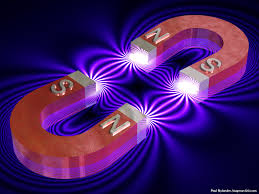
Any object that exhibits magnetic properties is called a magnet. Every magnet has two points, or poles, where most of its strength is concentrated; these are designated as a north-seeking pole, or north pole, and a south-seeking pole, or south pole, because a suspended magnet tends to orient itself along a north-south line. Since a magnet has two poles, it is sometimes called a magnetic dipole, being analogous to an electric dipole, composed of two opposite charges. The like poles of different magnets repel each other, and the unlike poles attract each other.
One remarkable property of magnets is that whenever a magnet is broken, a north pole will appear at one of the broken faces and a south pole at the other, such that each piece has its own north and south poles. It is impossible to isolate a single magnetic pole, regardless of how many times a magnet is broken or how small the fragments become. (The theoretical question as to the possible existence in any state of a single magnetic pole, called a monopole, is still considered open by physicists; experiments to date have failed to detect one.)
From his study of magnetism, C. A. Coulomb in the 18th cent. found that the magnetic forces between two poles followed an inverse-square law of the same form as that describing the forces between electric charges. The law states that the force of attraction or repulsion between two magnetic poles is directly proportional to the product of the strengths of the poles and inversely proportional to the square of the distance between them.
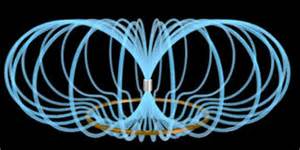
As with electric charges, the effect of this magnetic force acting at a distance is expressed in terms of a field of force. A magnetic pole sets up a field in the space around it that exerts a force on magnetic materials. The field can be visualized in terms of lines of induction (similar to the lines of force of an electric field). These imaginary lines indicate the direction of the field in a given region. By convention they originate at the north pole of a magnet and form loops that end at the south pole either of the same magnet or of some other nearby magnet (see also flux, magnetic). The lines are spaced so that the number per unit area is proportional to the field strength in a given area. Thus, the lines converge near the poles, where the field is strong, and spread out as their distance from the poles increases.
A picture of these lines of induction can be made by sprinkling iron filings on a piece of paper placed over a magnet. The individual pieces of iron become magnetized by entering a magnetic field, i.e., they act like tiny magnets, lining themselves up along the lines of induction. By using variously shaped magnets and various combinations of more than one magnet, representations of the field in these different situations can be obtained.
The Columbia Electronic Encyclopedia, 6th ed. Copyright © 2012, Columbia University Press. All rights reserved.
































Conservation of Energy
Energy can be defined as the capacity for doing work. It may exist in a variety of forms and may be transformed from one type of energy to another. However, these energy transformations are constrained by a fundamental principle, the Conservation of Energy principle. One way to state this principle is "Energy can neither be created nor destroyed". Another approach is to say that the total energy of an isolated system remains constant.
Conservation Laws
If a system does not interact with its environment in any way, then certain mechanical properties of the system cannot change. They are sometimes called "constants of the motion". These quantities are said to be "conserved" and the conservation laws which result can be considered to be the most fundamental principles of mechanics. In mechanics, examples of conserved quantities are energy, momentum, and angular momentum. The conservation laws are exact for an isolated system.
Stated here as principles of mechanics, these conservation laws have far-reaching implications as symmetries of nature which we do not see violated. They serve as a strong constraint on any theory in any branch of science.
An Isolated System (Closed System)
An isolated system implies a collection of matter which does not interact with the rest of the universe at all - and as far as we know there are really no such systems. There is no shield against gravity, and the electromagnetic force is infinite in range. But in order to focus on basic principles, it is useful to postulate such a system to clarify the nature of physical laws. In particular, the conservation laws can be presumed to be exact when referring to an isolated system:
Conservation of Energy: the total energy of the system is constant.
Conservation of Momentum: the mass times the velocity of the center of mass is constant.
Conservation of Angular Momentum: The total angular momentum of the system is constant.
Newton's Third Law: No net force can be generated within the system since all internal forces occur in opposing pairs. The acceleration of the center of mass is zero.
YOUR SOURCE FOR PEAK PERFORMANCE MAGNETS
A GREAT TUTORIAL ON MAGNETISM FROM EXPLAINTHATSTUFF.COM